Are the assumptions you make about age, limiting opportunity at work?
There is an ongoing conversation about inclusion in STEM (Science, Technology, Engineering and Mathematics). Age tends to be the dimension that is over-looked. When you consider the reality of today’s workforce: five generations working side by side, youth unemployment in the UK sitting at 16%, and one in nine employees now working beyond their 65th birthday – why aren’t we discussing it? After all, we are living and working longer and collaborating across wider age spans than at any point in modern history; don’t we need to start calling out and addressing age-based assumptions?
This is not just a general workforce issue. The government’s own Diversity in UK Tech report (2025) found that professionals aged 50 and over make up 31% of the UK’s working-age population, yet only a fifth of the tech workforce, a gap it warns will make existing skills shortages worse if left unaddressed. Separate research from CW Jobs found that 41% of tech workers said they had encountered age discrimination at work. While we may assume ageism is something that happens to older workers alone, it is worth noting that the same research highlighted anecdotal reports of some employers favouring more experienced colleagues over younger talent.
The hidden assumptions that shape opportunity
Ageism rarely appears as explicit discrimination. It surfaces in the quiet shortcuts our brains take, the language we use and the stories we tell ourselves about what different age groups must be like. For example:
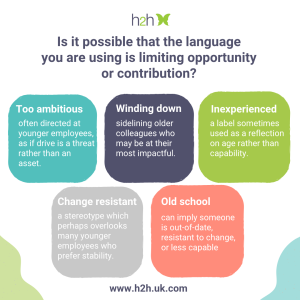
When assumptions are addressed they can materialize in the workplace as unbalanced workloads, who gets airtime in meetings, who gets trained, and ultimately who gets to belong. In an operational environment, where innovation depends on diverse thinking, these shortcuts can be especially costly.
Could age bias be going unnoticed in our everyday interactions?
Age‑coded behaviour often feels subtle, but its impact is anything but. People managers can start by observing and seeing if some of these behaviours are present across their teams.
- Meetings: Who speaks the most? Who gets interrupted? Are younger colleagues dismissed as naïve? Are older colleagues treated as blockers?
- Team dynamics: Do different age groups collaborate meaningfully, or do they cluster into generational silos?
- Job descriptions/adverts: Words like “digital native”, “high‑energy”, or “high potential” can quietly signal who is welcome.
- Performance conversations: Are expectations consistent across age groups, or do assumptions creep in?
- Development opportunities: Is training offered equitably, or do you assume some people are “not looking to grow”?
- Mentoring; Are you intentionally creating two‑way learning across generations?
- Systems and processes: What do your promotion, pay, and retention data reveal about age‑related trends?
- Challenge culture: Do people feel safe calling out age‑related assumptions when they hear them?
The challenging work begins when you ask:
Are the assumptions I’m making limiting opportunity, contribution, or belonging for people of different ages?
If the answer is “possibly”, then you have a starting point.
Age is the one characteristic that every single one of us will experience if we’re lucky. Unlike other protected characteristics, age is universal and dynamic and we all move through it. In a world where careers span 50+ years, where people retrain multiple times, and where skills evolve at pace, organisations cannot afford to let outdated assumptions shape opportunity.
Creating an age‑inclusive workplace isn’t about treating everyone the same. It’s about intentionally designing environments where people at every life stage can contribute fully, grow meaningfully, and belong authentically. As Harvard Business Review’s research on the multi-generational workplace suggests, generational distrust and ageism are seeping into organisations worldwide, with differences in communication style and technology preferences fuelling stereotypes that hurt team performance. It does not have to be this way. We are living and working longer. The question is whether our workplaces are evolving fast enough to match that reality.
If you would like an informal chat with us about what inclusion looks like in an operational environment then contact us at hello@h2h.uk.com or click here to request a call.
The study from Harvard Buisness Review is available to buy here or you can download their previous study on Unlocking the benefits of a multi-generational workforce here.