How Can Organisations Build Capability Through Chaos?
At the h2h people performance summit we were discussing chaos and capability. If it feels chaotic for you at the moment, you’re not imagining it: a lot of our delegates feel the same. Across STEM, manufacturing, engineering, life sciences and technology sectors, organisations are managing a complex mix of economic uncertainty, geopolitical instability, rapid technological change, workforce transformation and increasing regulatory expectations. For many leaders, it can feel as though the ground is constantly shifting beneath their feet.
We had some insightful discussions and concluded that whilst today’s challenges are significant, they are not entirely new. Every generation has experienced its’ own unique form of disruption and lived through wars, financial crises, industrial revolutions, periods of social unrest and fundamental shifts in employment practices. Organisations adapted, work forces evolved and new opportunities emerged. We have a tendency to believe that our current challenges are unprecedented, but history tells us that uncertainty has always been part of organisational life. However, what feels different at the moment is the pace and rate of change..
Previous generations often had decades to adapt to major changes. Today, advances in artificial intelligence, automation, digitalisation and global connectivity mean that disruption arrives faster and from multiple directions simultaneously. Political events in one part of the world can impact supply chains overnight and a technological breakthrough can potentially change a business model within months rather than years – this speed of change creates a sense of continuous chaos
But perhaps the most important questions for leaders is this; can we use capability to drive our organisation through the and should we be trying to eliminate chaos altogether? The answer to the second part of this question is probably, no.
A degree of uncertainty can actually be healthy as without pressure to change:
- organisations can become complacent
- innovation slows downs
- decision-making becomes cautious
- and organisations lose their ability to adapt.
Constructive tension often encourages creativity, collaboration and fresh thinking. Some of the greatest advances in science, engineering and industry have emerged because people were forced to solve difficult problems in turbulent conditions.
The challenge comes when chaos moves beyond healthy pressure and becomes overwhelming. Too much uncertainty on the other hand can lead to reactive decision making, employee burnout and a culture where people become focused on surviving rather than improving. When teams are constantly reacting to external events, capability development is often one of the first activities to be slip. Ironically, this is exactly when organisations need it most.
We need to try to get this delicate balance right. Successful organisations can’t ignore uncertainty, nor do they become consumed by it. Instead, they focus on building capabilities that enable them to face whatever comes next.
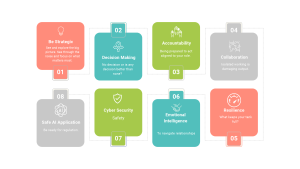
At our recent conference several capabilities consistently emerged as priorities. Strategic decision-making is as critical as ever, allowing leaders to make progress even when they don’t have all the answers whilst adaptability enables organisations to respond quickly to changing circumstances. Collaboration becomes increasingly important as complex problems demand expertise from across divisions and disciplines and resilience will support individuals and teams to maintain performance under pressure. Cyber security and digital capability are also becoming essential skills rather than specialist disciplines while emotional intelligence will always be key in helping leaders to bring their people with them through change.
Perhaps the most important leadership lesson though is that waiting for certainty is rarely an option. Great leaders do not necessarily know exactly what the future holds but they try to create clarity where they can, communicate with the workforce honestly about what they cannot control and help people take the next meaningful step forward. The organisations that thrive through uncertainty are not those that successfully predict every challenge, they are the ones that continuously build their capability to respond.
Chaos may be unavoidable, but capability is a choice and while the future may feel uncertain, investing in the skills, behaviours and leadership needed to navigate complexity remains one of the most reliable ways to build organisational success, whatever challenges lie ahead.
Contact us at hello@h2h.uk.com to find out more about our insights into driving capability through your chaos.