Engineering empathy: why coaching cultures are crucial in the STEM sector?
In the scientific and engineering industry, complexity and innovation drivers are high and it is important in these businesses to try to create an environment where a coaching culture is embedded into everyday leadership. Within STEM, organisational coaching culture is crucial – it doesn’t rely on a one-off intervention, workshop or training programme – it needs to be business as usual (BAU).
When done well the key principles of active listening, feedback and growth will help employees to align their personal development objectives with business goals and help the business to thrive.
Why is this so important in the STEM sector in particular?
It is well recognised that the ‘purely technical’ workplace is a thing of the past. Managers have often been appointed, in part due to their technical expertise and skill, but managing people is a whole other ball game and perhaps one where they might feel uncertain at times. People are of course complex and embedding coaching practices as part of your daily interactions with your team can make a real difference. In the innovative and experimental STEM sector a coaching culture approach supports cross-functional collaboration, encourages curiosity and perhaps most importantly helps teams navigate failure when it doesn’t go according to plan. Furthermore, the multi-generational dynamics of the workplace now require a more people-centric approach to leadership.
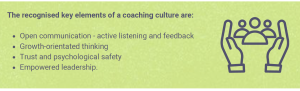
These need to be consistently deployed as part of everyday leadership – your BAU. This will enable all team members to have reflective and constructive conversations which support each other’s growth and help with problem solving. Many top-performing engineering teams now credit coaching with enhanced performance, higher morale and more efficient delivery. (see the recent h2h coaching case study)
Putting a coaching culture into practice takes time and a strategic approach, especially if this is something that is fairly new for your organisation. As is often the case, when the Senior Leadership Team leads by example, the chances of success are much improved. If your managers are unaware of the coaching fundamentals, training in what this looks and sounds like is a good place to start. At h2h we often reference the 70-20-10 model which shows that 70% of the learning comes from experiential, on-the-job activities such as team meetings, project reviews, de-briefs and performance check-ins.
Being mindful of the various generational expectations and communications styles within your workforce is a good tip when trying to roll this out across the organisation. In fact, this approach may help you to bridge any age gaps and foster mutual respect. Peer coaching programmes and sharing of cross-functional knowledge may be another avenue you choose to explore alongside reverse mentoring which can help to promote an inclusive and sustainable culture where all voices are heard. There are also several digital platforms, tool kits and tech solutions that you may want to look into if you need to scale this up across a large organisation and which can help you measure impact and track results.
Ultimately, engineering empathy through a coaching culture may just be your competitive advantage. From attracting great talent, in onboarding systems through to employee engagement and succession planning. It is the strategic option for businesses, particularly in the scientific and engineering sector, who want to future-proof their workforce, unlock innovation and build resilient, inclusive teams.
At h2h we offer a range of coaching services tailored to individual or organisational requirements, including:
- One-to-one coaching
- Transition coaching
- Team coaching
- Developing internal coaching capability
Contact us at: hello@h2h.uk.com for more information on our coaching services.