The era of the portfolio career
Long gone are the days of one employer, one job and one career ladder, today people will often have at least 2 or 3 career changes over the life span of their working lives. However, in the last 5 years the world of work has shifted significantly due to rapid advances in technology, AI, the rise of flexible working and the multi-generational workplace. People are now looking for more variety and fluidity in their work and more balance in their lives, where multiple roles, part-time positions, freelance and side-hustles are combined to make up a portfolio career.
“I think more people of all ages will move towards portfolio careers and approach their working life with a more flexible attitude. With skills shortages impacting all industries – particularly STEM sectors – we will need to think differently about how to get the people we need in the roles that are so vital to the economy.” – Senior HR Leader
A portfolio career brings several benefits for the employee such as flexibility and autonomy which dovetails well with the emerging trend of more project based and part-time roles. This shift in approach is of particular appeal to those under 30 and can lead to an improved set of transferable skills and adaptability amongst this population. There are many articles on the benefits for individuals such as this from Forbes on non-linear careers. However, this also needs to be counterbalanced with the flip side of the coin – potential instability, isolation and perhaps some push back from employers who may question commitment and reliability.
Advice is not so readily available for employers. So how can employers react to the emerging trend of the portfolio career and use this to their advantage? In a nutshell we cannot resist this shift and need to rethink traditional systems and practices in order to create an environment that attracts and retains multi-skilled professionals and embraces flexible talent models. Easy to say, but not so easy to do.
Organisations should consider the following:
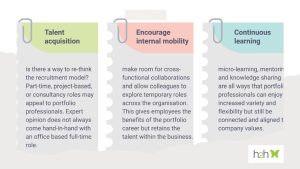
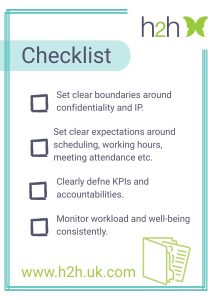
Whilst this approach can drive innovation, attract top talent and make your organisation more agile and adaptable, it is essential that you take a strategic approach to managing non-traditional career paths and:
The emerging trend of the portfolio career is set to stay for some time and needs some careful thought and consideration around how this may work for you and your business. Making room within your current frameworks to accommodate some aspects of this non-linear model might be part of the solution to help you to plug any skills gaps shortages and build a more agile organisation, fully equipped to navigate periods of uncertainty.
Click here to download our free, full report on the employee life cycle – From onboarding to retirement, email us at hello@h2h.uk.com or find out more about us at www.h2h.uk.com